Abstract
Manganese (Mn) belongs to the manganese group, Group , which comprises the four transition metals manganese (Mn), technetium (Tc), rhenium (Re), and bohrium (Bh).
Manganese ores occur mainly as oxides:
- Pyrolusite,
- Hausmannite,
- Manganosite,
- Rhodochrosite,
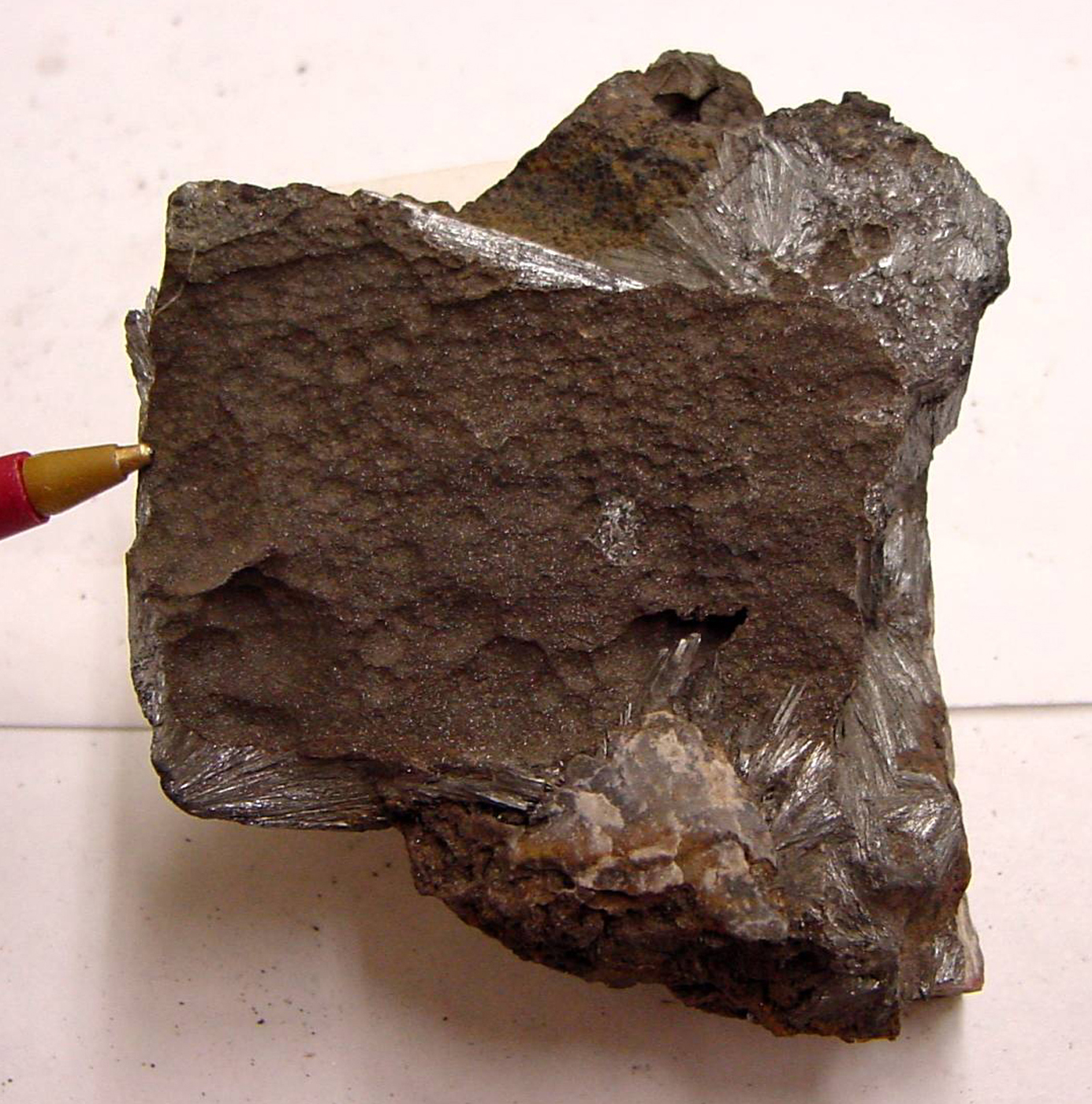
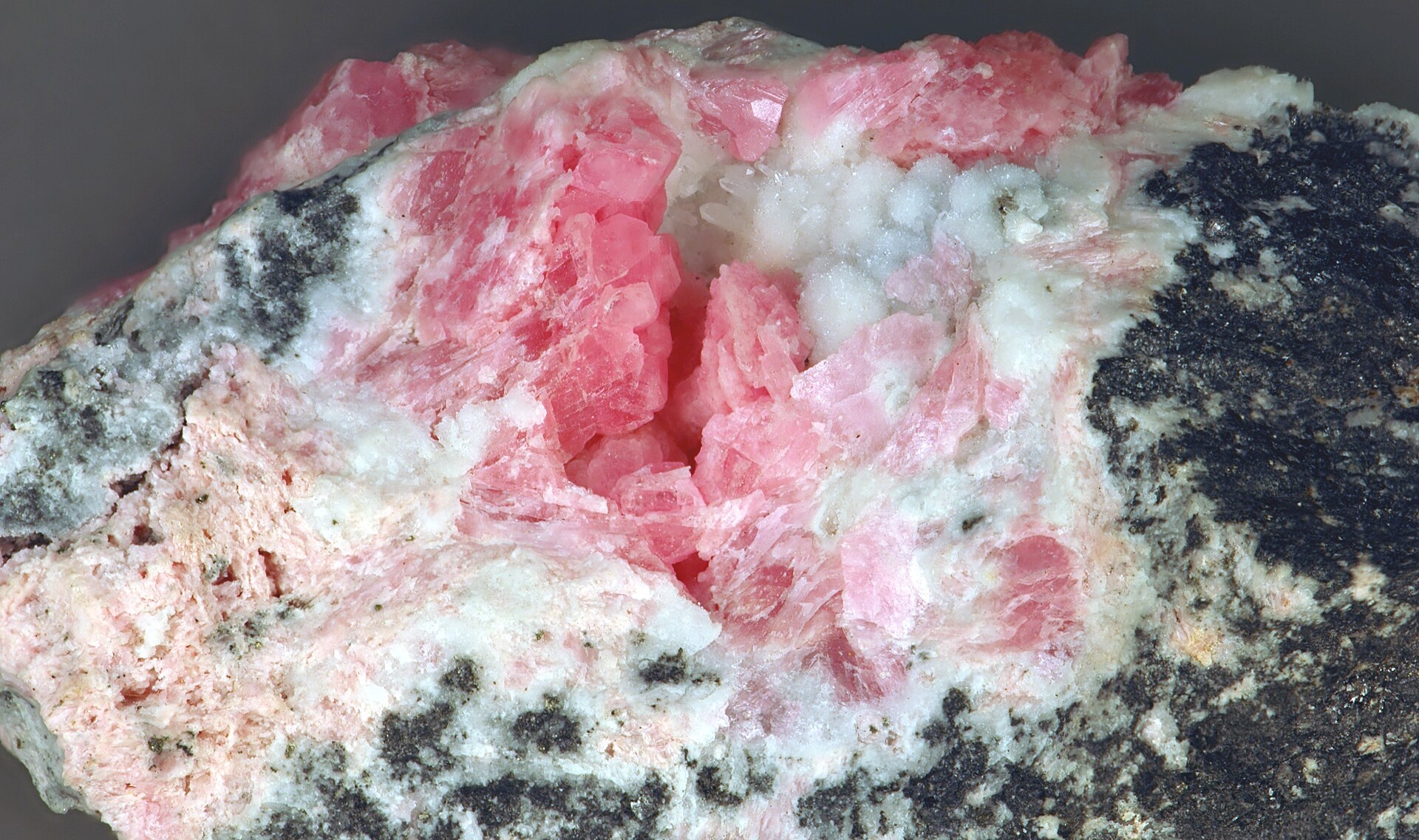
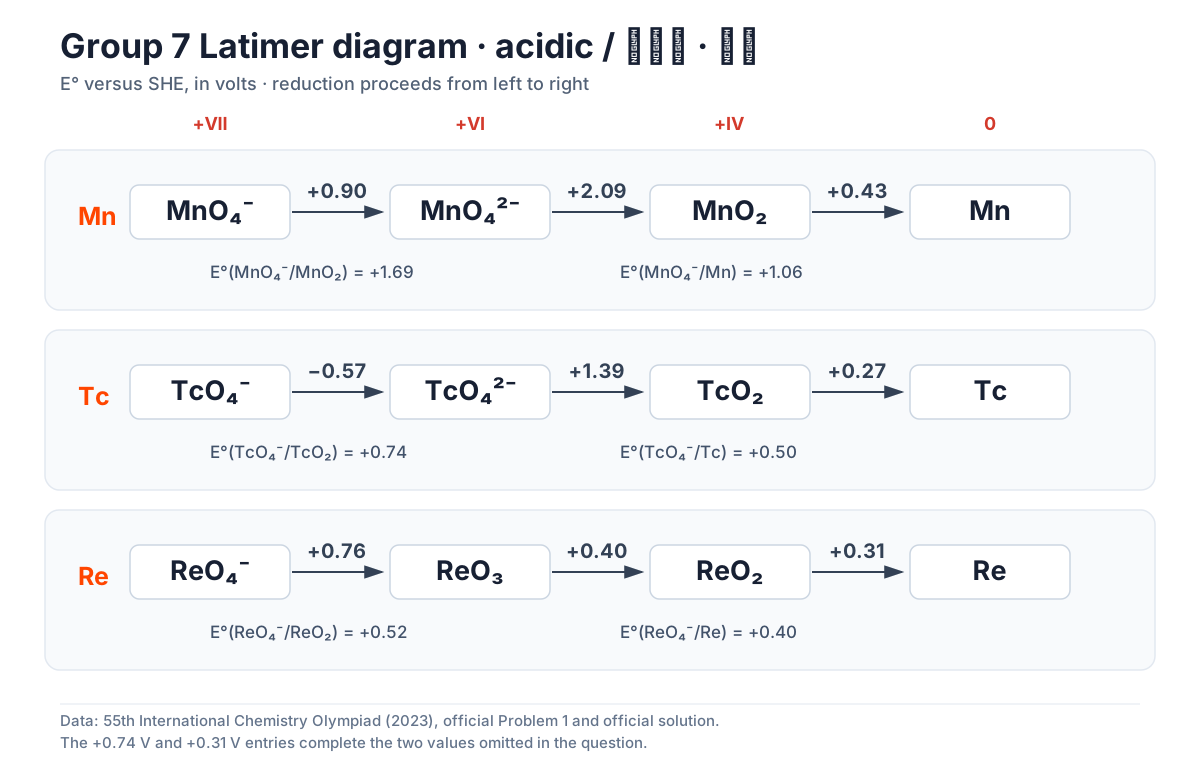
The ground-state valence-electron configuration of the manganese-group elements is , and their highest oxidation state is . Manganese exhibits the widest range of oxidation states in the group. The state is its most common and most stable state; occurs in solids, solutions, and coordination compounds, while is strongly oxidizing.
Unlike manganese, Tc and Re most commonly and stably adopt the oxidation state, which is only weakly oxidizing. Their and lower oxidation states are unstable and strongly reducing.
In summary, down the manganese group:
- The stability of high oxidation states increases
- The stability of low oxidation states decreases
With that context established, this opening article on the manganese group focuses on manganese itself.
The Element
Metallic manganese is silvery white. Manganese exposed to air, as well as powdered manganese, appears gray.
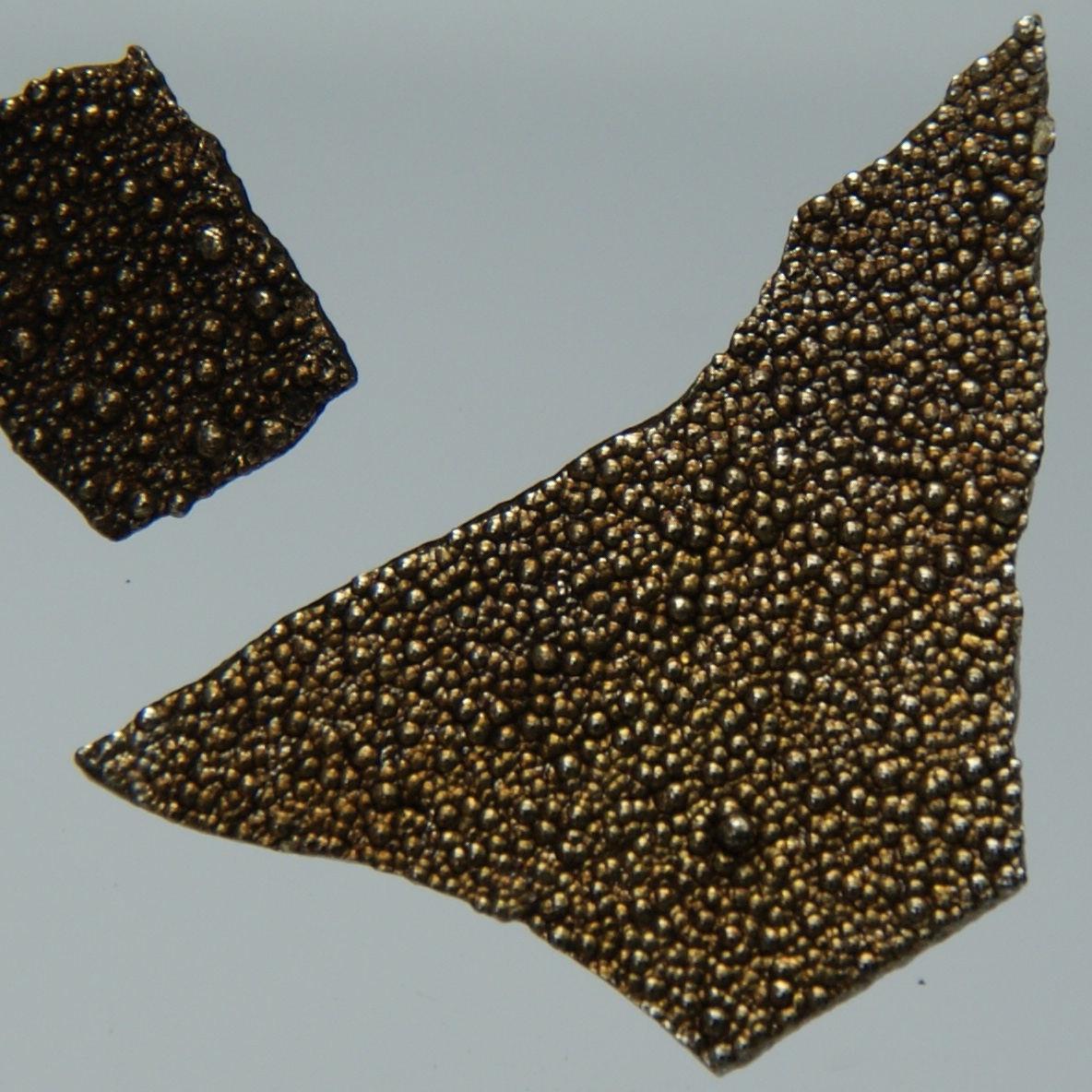
Pure manganese can be prepared by reducing or through an aluminothermic reaction.
The electrode potential shows that manganese is an active metal. It dissolves in cold, dilute, non-oxidizing acids, for example:
At room temperature, manganese is not highly reactive toward nonmetals, but it reacts readily on heating:
- Heating in air produces
- At high temperatures it reacts with halogens, sulfur, carbon, and phosphorus
- It reacts very little with cold water, but reacts with hot water to form and release , similarly to magnesium
Compounds
Common manganese compounds include:
- salts
- oxides
- Permanganates
Soluble Salts
Salts of derived from strong acids are soluble:
The five d electrons of have parallel spins. Because the probability of a d-d transition is low, its compounds are generally only weakly colored.
- Concentrated solutions are pink
- Dilute solutions are nearly colorless
Most hydrated salts are pink or rose-colored, for example:
The following anhydrous salts are white:
Sparingly Soluble Compounds
The hydroxide and most weak-acid salts of are sparingly soluble.
- : pink
- : white
- -: green
- : white
These substances dissolve readily in strong acids, a general pattern among transition-metal compounds.
Note that is insoluble in water but dissolves in weak acids such as , so it cannot be precipitated from an acidic solution.
Reducing Properties
In alkaline solution, is a fairly strong reducing agent and is readily oxidized to .
Both aqueous ammonia and strong bases convert into basic, nearly white.
is oxidized extremely readily. Even the small amount of dissolved oxygen in water can oxidize it to brownish-black, also written as or . This reaction can be used to determine dissolved oxygen.
When precipitates of , , or stand in air or are heated, atmospheric oxygen oxidizes them to .
In an oxygen-free environment, MnO can be prepared by the thermal decomposition of or .
In acidic solution, is a weaker reducing agent:
Strong oxidizing agents can oxidize to :
The first two reactions are commonly used to identify .
The concentration must not be too high, especially in the first reaction. Otherwise readily comproportionates with to form brownish-black.
When a salt is heated and its anion is oxidizing, is oxidized:
By analogy, one possible decomposition pathway of nitrosyl perchlorate, , is:
Coordination Compounds
Weak-Field Ligands: High-Spin Octahedral Complexes
has the electron configuration . Its high-spin octahedral complexes with weak-field ligands have the electron arrangement and a crystal-field stabilization energy of zero.
The hydrated ion is extremely pale pink, almost invisible below a concentration of . In these high-spin compounds, a d-d transition requires not only promotion from a lower to a higher energy level but also a reversal of electron spin. This is a spin-forbidden transition. Because such transitions are very unlikely, absorption in the visible region is weak.
Weak-Field Ligands: High-Spin Tetrahedral Complexes
In ethanol, forms yellow, where . Its electron arrangement is , and .
Strong-Field Ligands: Low-Spin Octahedral Complexes
Only with certain strong-field ligands forms colored, low-spin complexes. An example is blue-violet, with electron arrangement and . In air, this compound is readily oxidized to brownish-red.
Compounds
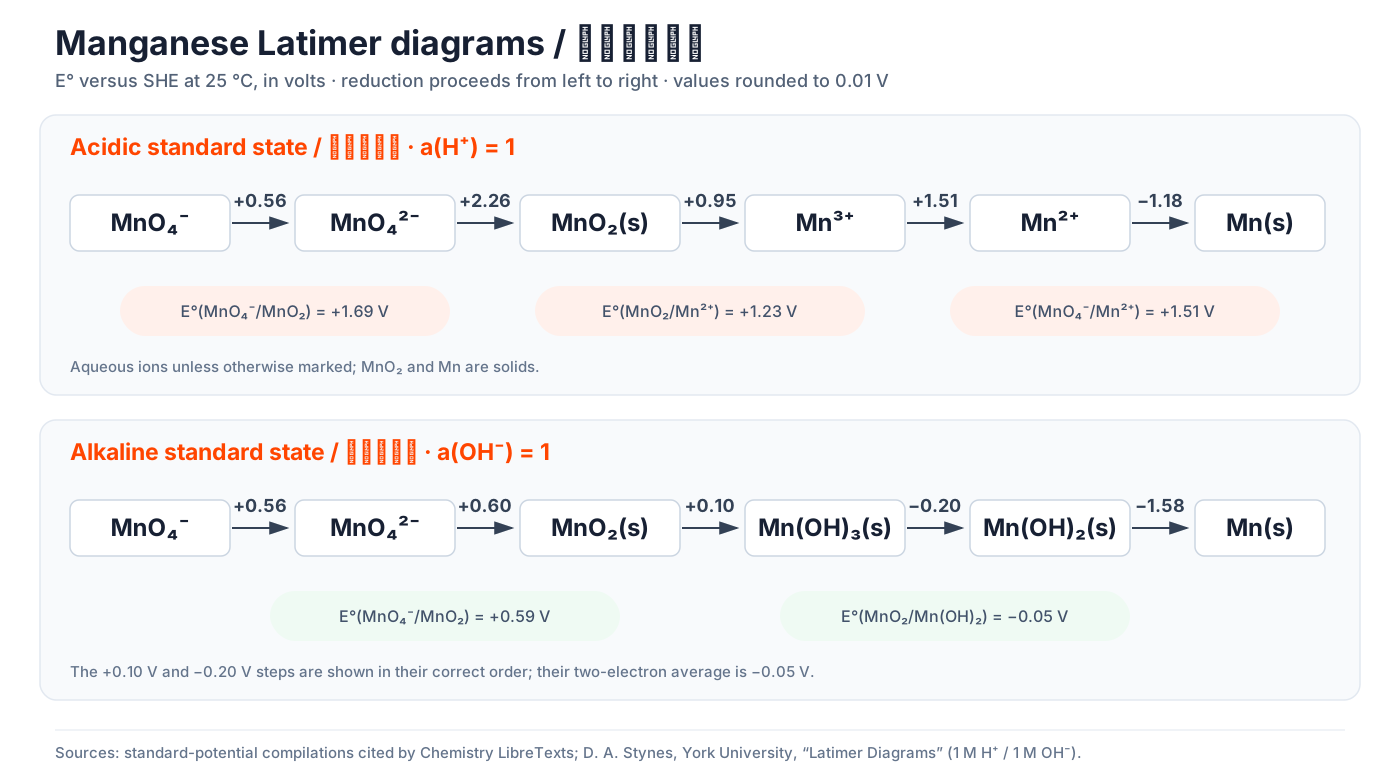
The Latimer diagram shows that is strongly oxidizing. It is unstable in solution and readily disproportionates.
Important compounds include:
- : reddish purple
- : reddish purple, prepared by reacting with
- : black, prepared by heating below
Important coordination compounds include:
- : brownish red
- : purple
Compounds
powder is black. The precipitate formed in solution is the brownish-black hydrate .
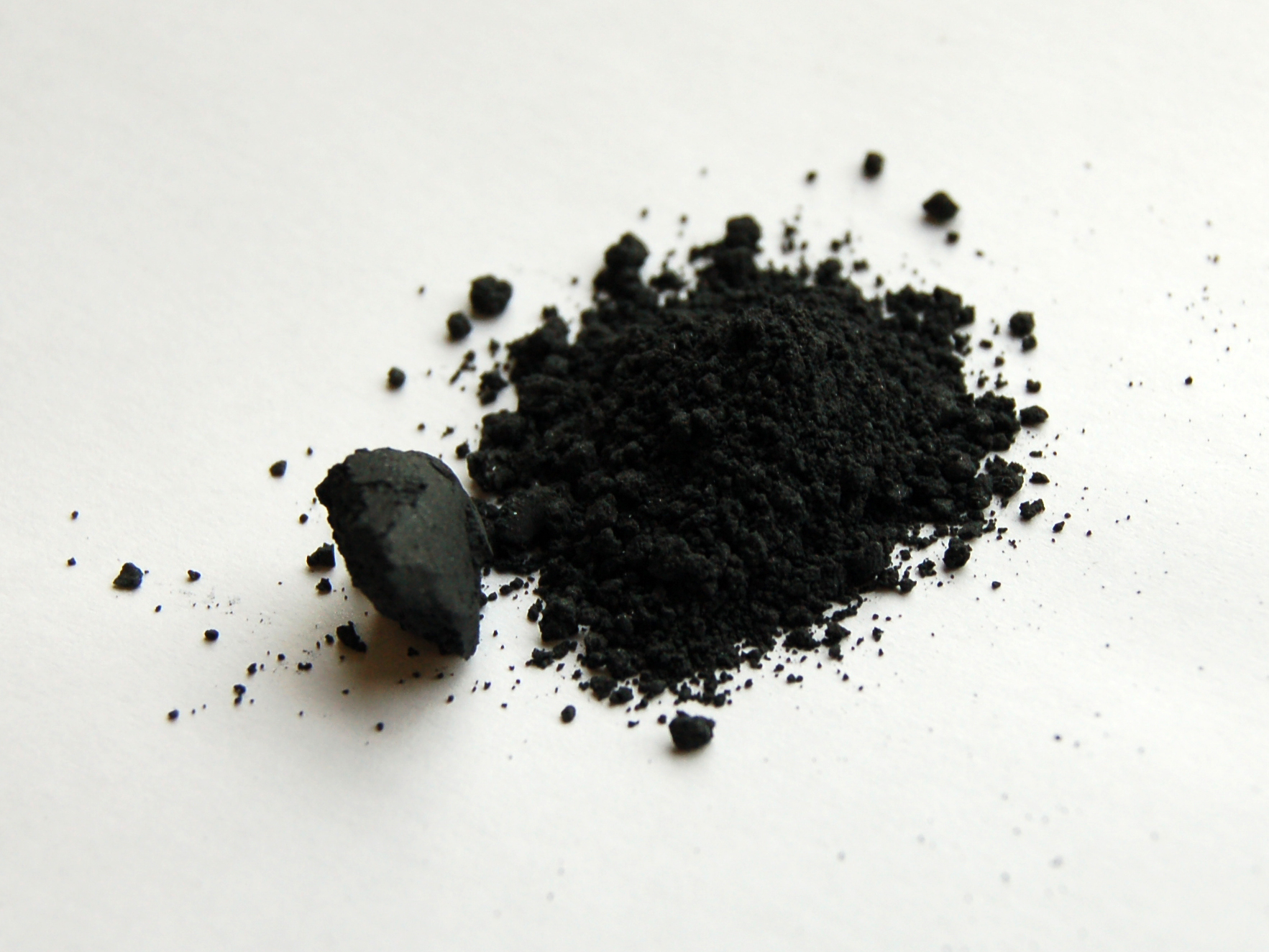
Under ordinary conditions, is very stable. It is insoluble in , dilute acids, and dilute bases, and does not disproportionate in acid or base. However, is amphoteric and reacts slowly with concentrated acids and bases.
Fusion of with in the absence of air produces the manganite :
The fact that reacts with in this way demonstrates its acidic character.
Because is an intermediate oxidation state, it can act as either an oxidizing or a reducing agent.
In strong acid, is a powerful oxidizing agent. It oxidizes to and to ; heating it with concentrated hydrochloric acid produces chlorine.
Heat a test tube containing a mixture of powder and concentrated in a water bath. After cooling and standing, the upper part of the test tube becomes reddish purple, indicating the formation of :
is unstable. At higher temperatures it converts into the more stable :
Under alkaline conditions, can be oxidized to . Mix with a base and an oxidizing agent such as potassium chlorate (2026 Beijing Gaokao chemistry) or potassium nitrate, or use oxygen from air, and heat the mixture to fusion:
Compounds
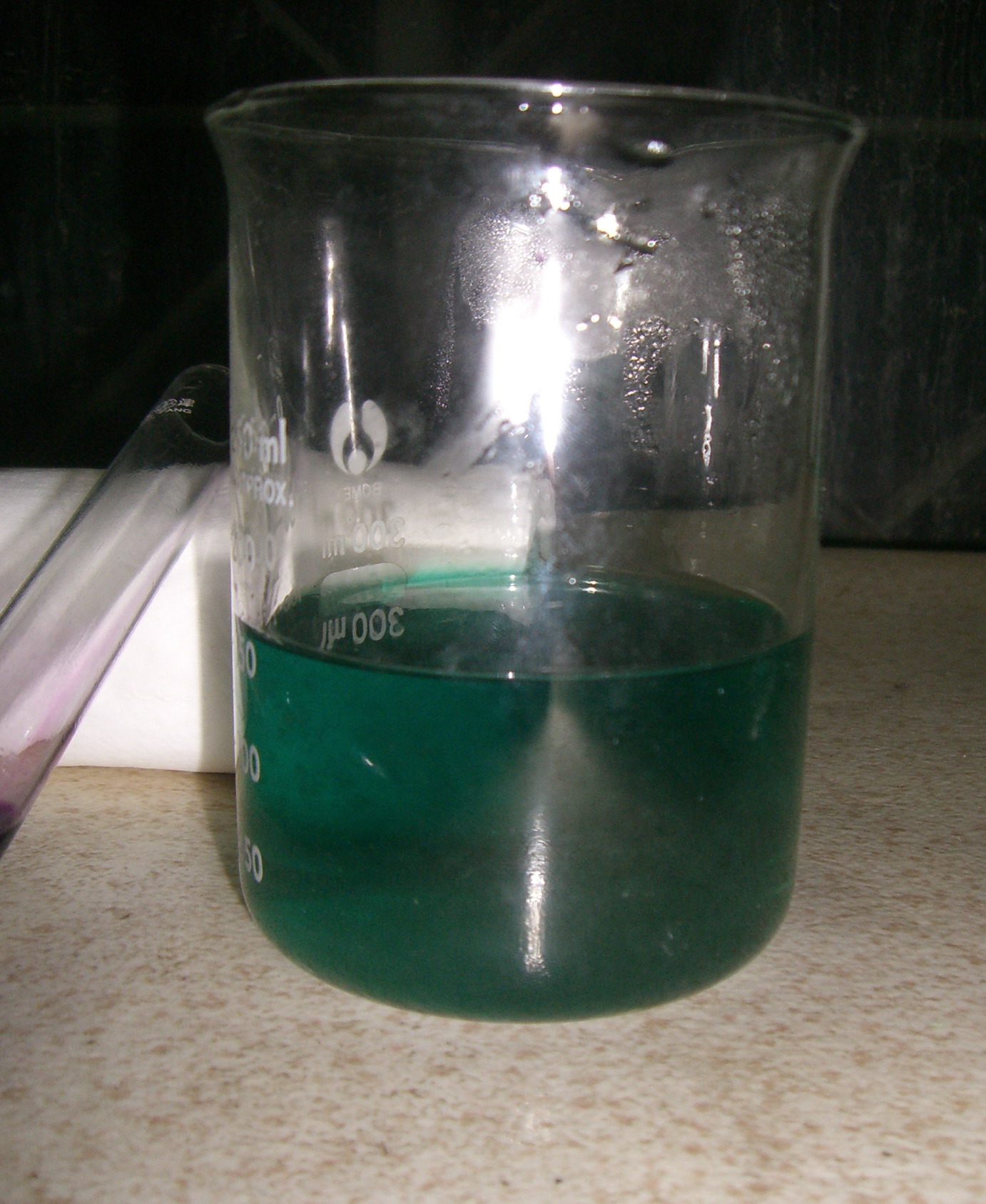
Among compounds, potassium manganate, , is relatively stable. It forms deep-green crystals and decomposes at into potassium manganite, , and oxygen. is relatively stable in strongly alkaline solution.
is stable only in concentrated strong base; acidification or a decrease in alkalinity causes disproportionation. The same reaction can be written in acidic-medium and aqueous forms as follows:
Because the latter form produces , increasing alkalinity shifts the equilibrium to the left. Potassium manganate is stable only in a concentrated strong base, at .
Heat a mixture of , , and to fusion in a dry test tube. A green product forms. After cooling to room temperature, adding a small amount of water gives a green solution, showing that potassium manganate has formed. Adding a large amount of water immediately turns the solution reddish purple and produces a brown precipitate. Dilution lowers the base concentration, allowing manganate to disproportionate into and .
Note that producing potassium permanganate by this route wastes one-third of the manganese (2026 Beijing Gaokao chemistry).
Compounds
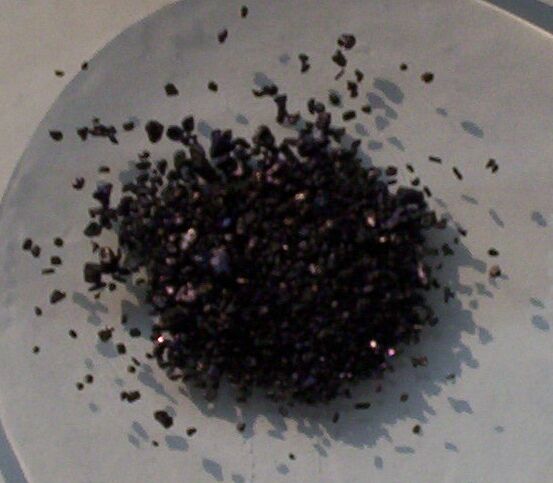
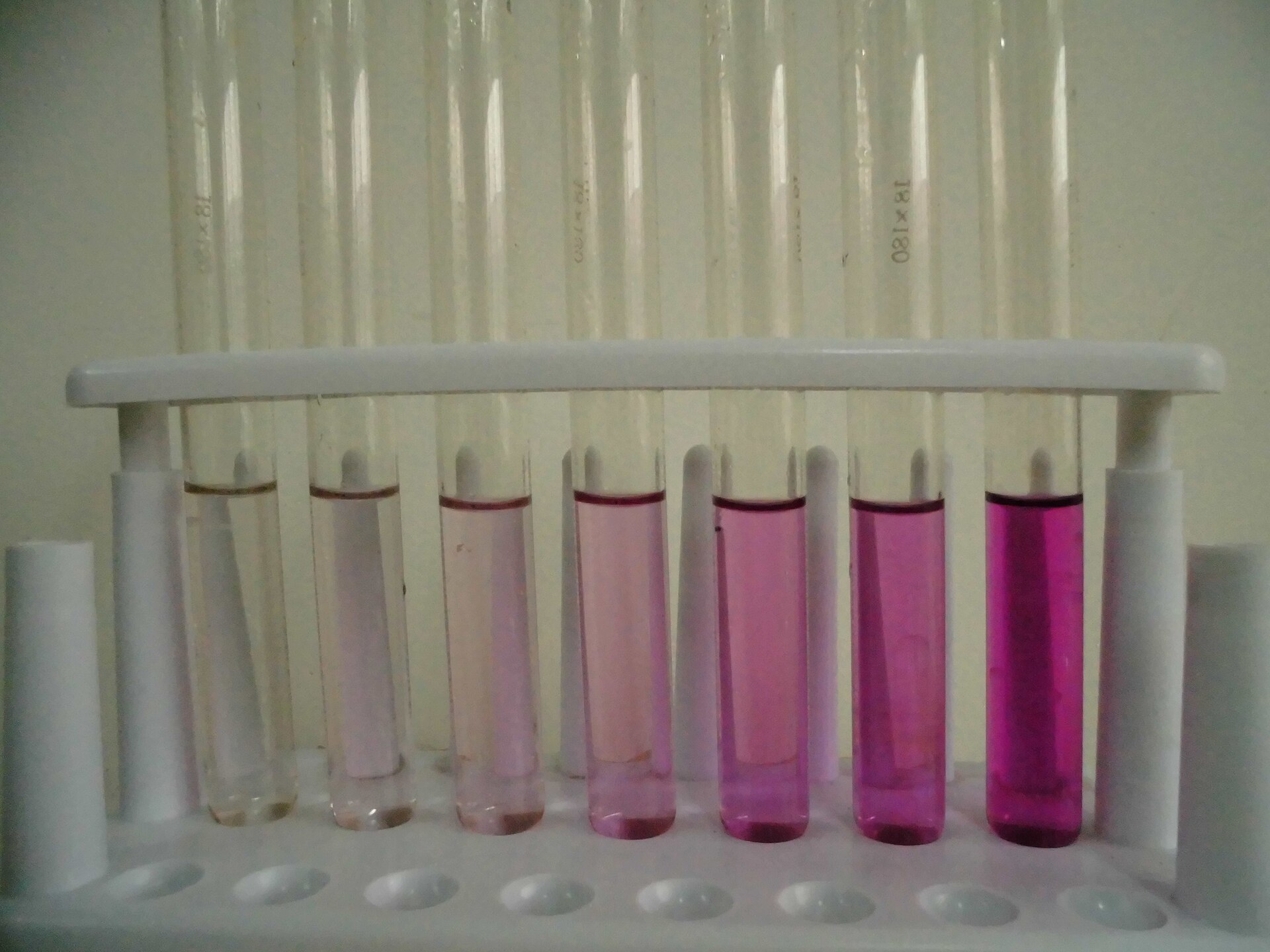
The most important compound is potassium permanganate, , which forms purple-black crystals. The color of its aqueous solution depends on concentration. From low to high concentration, the solution appears pink, red, reddish purple, purple, and finally purple-black. Sodium permanganate, , is deliquescent and difficult to purify.
Strong Oxidizing Properties
is one of the most important and widely used oxidizing agents. Its oxidizing power and reduction product depend on the acidity of the medium. It is reduced to in strongly acidic solution, to in strongly alkaline solution, and to in nearly neutral solution because these products are stable in their respective media. Its reactions with illustrate this behavior:
Acidic:
Neutral:
Alkaline:
In acidic solution, is a very strong oxidizing agent:
It can oxidize , , , and many other species:
The reaction between and hydrochloric acid can be used to prepare chlorine in the laboratory, but gas generation cannot be stopped on demand. Because is also more expensive than , laboratories more commonly prepare chlorine by reacting with concentrated hydrochloric acid.
Under acidic conditions, reacts quantitatively with and can therefore be standardized using oxalic acid:
also reacts quantitatively with and can be used to determine its concentration.
In volumetric analysis, is commonly used as a redox titrant. In acidic solution, is reduced to . A slight excess of immediately turns the solution red, whereas a dilute solution is essentially colorless and does not obscure the endpoint. The titrant therefore acts as its own indicator.
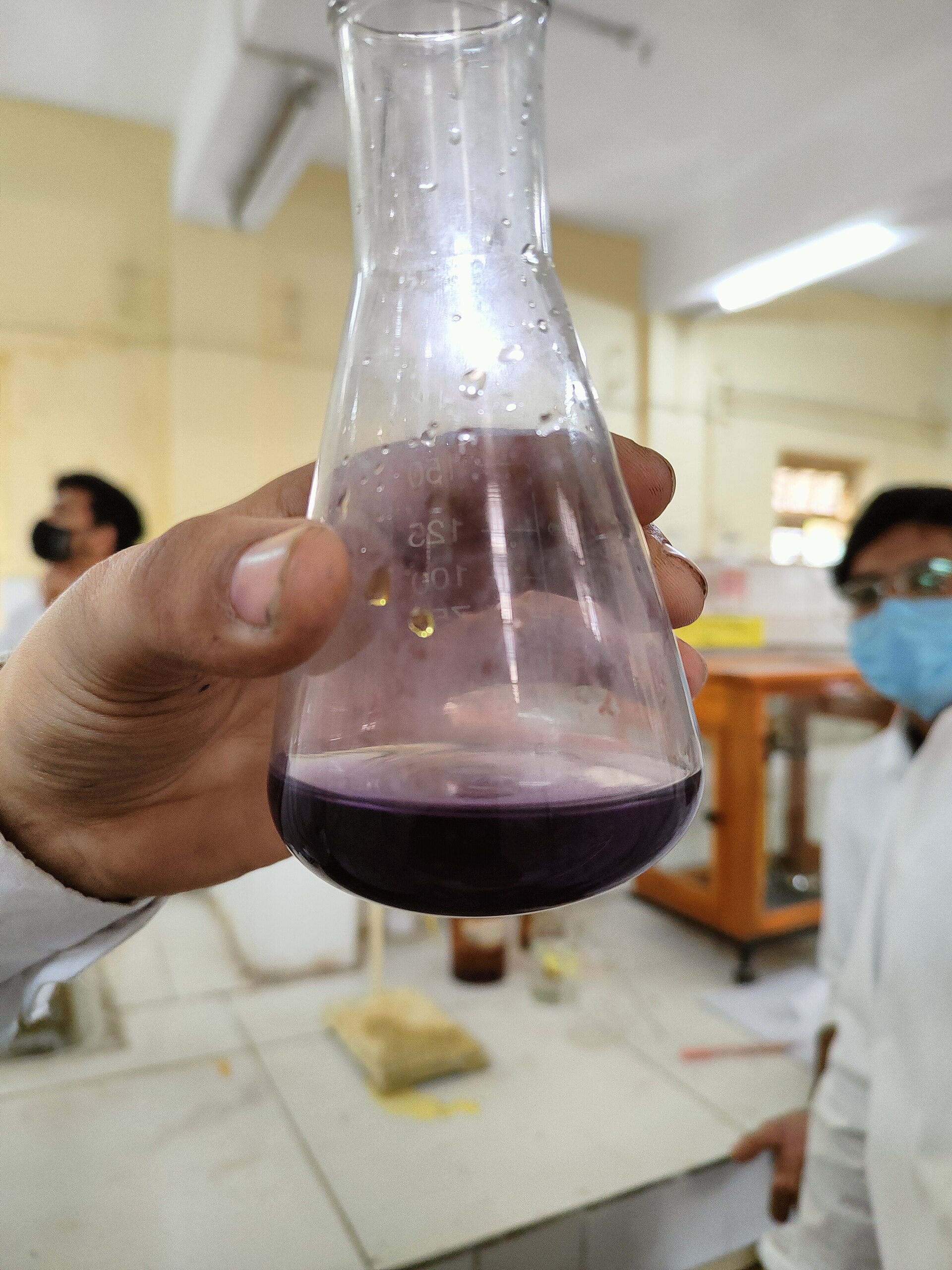
As an oxidizing agent, is used in many organic syntheses, including the preparation of saccharin, ascorbic acid (vitamin C), and niacin. It is also used for disinfection and for treating drinking and industrial water.
Instability
Permanganates are strongly oxidizing and unstable. They decompose appreciably in acidic solution and slowly in neutral or mildly alkaline solution:
Light catalyzes the decomposition of potassium permanganate, so its solutions should be stored in brown bottles. Because decomposition causes the concentration to change over time, a standard potassium permanganate solution must be re-standardized before use.
Permanganates are more stable as solids than in solution, but they still decompose on heating. At about , forms , , and :
Heat gently in a dry test tube. Popping sounds are heard, and after they stop the solid has lost its original crystalline luster. Add a small amount of water and shake: the test-tube wall becomes green, showing that is among the decomposition products. Adding a large amount of water immediately turns the solution purple because disproportionates to form .
Cold concentrated sulfuric acid reacts with to form oily, dark-green manganese heptoxide, :
ignites on contact with organic matter, decomposes explosively when heated, and slowly releases at room temperature while converting to .
Preparation of Potassium Permanganate
Potassium permanganate is commonly prepared from pyrolusite, .
First prepare potassium manganate by heating a fused mixture of , , and (2026 Beijing Gaokao chemistry). The product is green potassium manganate:
Oxidation of with a strong oxidizing agent gives . Chlorine, for example, can be used:
Industrial production commonly uses electrolysis of a solution:
Anode reaction
Cathode reaction
Overall reaction
Exam Practice
Effect of Alkalinity on the Reducing Behavior of
(2022 Beijing Gaokao Chemistry, Question 19; adapted from the original paper)
An experimental group investigated the reactions of chlorine with manganese(II) compounds under different conditions.
Information:
i. Under suitable conditions, can be oxidized by or to (brown-black), (green), or (purple).
ii. In strongly alkaline solution, can be reduced by to .
iii. The oxidizing power of is independent of the acidity of the solution, whereas the oxidizing power of decreases as alkalinity increases.
The apparatus is shown below (supports omitted):
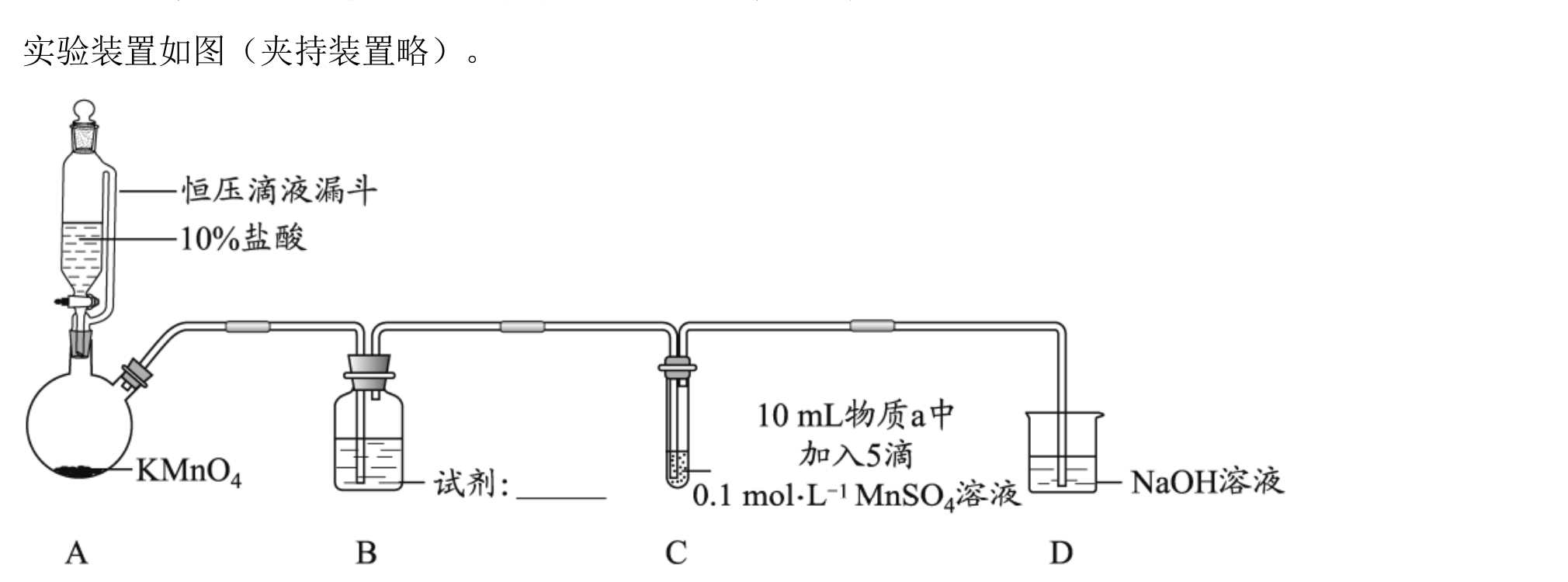
Vessel C was charged with of substance a and five drops of . Chlorine generated in A and washed in B was then passed into C.
| No. | Substance a | Before introducing | After introducing |
|---|---|---|---|
| I | Water | A colorless solution | A brown-black precipitate formed and did not change on standing |
| II | A white precipitate formed and slowly became brown-black in air | More brown-black precipitate formed; on standing, the solution became purple while solid remained | |
| III | A white precipitate formed and slowly became brown-black in air | More brown-black precipitate formed; on standing, the solution became purple while solid remained |
(1) The reagent in vessel B is saturated solution.
(2) Before chlorine was introduced, the equation for the conversion of the white precipitate into a brown-black precipitate in experiments II and III is .
(3) Comparing experiments I and II after chlorine was introduced shows that manganese(II) compounds can be oxidized only to under neutral or weakly acidic conditions, but to higher oxidation states under alkaline conditions.
(4) According to information ii, experiment III should have produced a green solution, but a purple solution was obtained. Two explanations were proposed:
- introducing may have reduced the alkalinity;
- excess oxidant may have oxidized further to .
① The equation for the reaction that could reduce the alkalinity is . Measurement showed that the alkalinity changed very little.
② To of the suspension from experiment III after standing, of was added. The solution rapidly changed from purple to green, after which the green color slowly deepened. The ionic equation for the rapid color change is ; the green color slowly deepened because was oxidized by , proving that the oxidant was in excess.
③ Another portion of the suspension was diluted with of water. The purple color slowly deepened. The reaction involved is .
④ In terms of reaction rates, experiment III did not yield a green solution because under strongly alkaline conditions, is faster than .
Focus on the competition between green and purple implied by the second explanation: is formed rapidly and consumed slowly, whereas is formed slowly and consumed rapidly. Part (4)② shows that the oxidation of by is slow, so it is not the principal factor.
Preparation, Purification, and Yield of Potassium Permanganate
(2026 Beijing Gaokao Chemistry, Question 19; adapted from the original paper)
An experimental group prepared potassium permanganate.
Information:
i. is a dark-green solid. It is soluble in water, stable under strongly alkaline conditions, and disproportionates under suitable conditions:
ii. In strongly alkaline solution, can be reduced by to .
iii. The solubility of increases with temperature.
(1) Preparation of
| Step | Procedure |
|---|---|
| I. Prepare | Heat , , and together in the molten state until reaction is complete, obtaining dark-green solid X |
| II. Prepare | Dissolve X in water and add until (about ). When the solution changes from green to purple-red, filter it to obtain about of solution Y and a brown-black solid |
| III. Purify | Concentrate Y in an evaporating dish using a water bath, cool to crystallize, filter, wash, and dry, obtaining purple-red solid Z |
① Complete the equation for the reaction in step I:
② In step II, disproportionates as pH decreases. If the reducing power of remains unchanged, its oxidizing power increases.
③ When a small sample of Z was dissolved, a purple-red solution and a small amount of brown-black were obtained.
(2) Investigating the source of in step III
① Student A proposed that reduced . In experiment i, Y was replaced with a solution containing and at . Repeating step III produced a solid containing . Student B argued that this result alone did not prove that acetate reduced permanganate because the experiment did not rule out interference from reduction of by .
② In blank experiment ii, Y was replaced with a solution containing and adjusted to with . Repeating step III produced no ; experiments i and ii therefore supported Student A's proposal.
③ Student C replaced with in experiment i. This confirmed that in step III could not reduce .
(3) Determination of purity and yield
Product was prepared from the quantities used in step I using the optimized procedure. One quarter of the product was made up to as the test solution. Under acidic conditions, the test solution was used to titrate a standard solution; was reduced to . The measured concentration was .
① The ionic equation for the titration is . Treat as a diprotic weak acid.
② The yield of is . []
Reaction of with a Solution
(2023 Haidian Second Mock Exam, Question 9) A group of students investigated whether metallic sodium can reduce in solution.
A piece of sodium about the size of a mung bean was placed in a dry test tube. Then of solution was added dropwise. A colorless gas formed, and the solution changed from reddish purple to light green because of .
was continuously bubbled through of solution while it was heated in a water bath. No obvious color change occurred.
Solid was added to of solution. The solution changed from reddish purple to light green.
Which statement is incorrect?
A. In Experiment 1, the sodium may also float on the solution, burn vigorously, and produce a yellow flame.
B. Experiment 2 shows that the color change in Experiment 1 is unrelated to the gas produced.
C. Experiment 3 suggests that the following reaction may occur in Experiment 1:
D. These experiments prove that metallic sodium can reduce in solution.
A: The observation resembles the reaction between sodium and water, so it is reasonable.
B: Experiment 2 shows that hydrogen cannot reduce and also accounts for the heat released when Na reacts with water, so it is reasonable.
C: The proposal is logically consistent and agrees with known inorganic chemistry, so it is reasonable.
D: The reduction of could instead result from the reaction proposed in C, so this conclusion is not justified.
Reaction of with a Solution
A group of students investigated the reaction between and solutions.
Reference information:
i. (yellow)
ii. is green and unstable under acidic conditions; low-concentration is colorless; and is a flesh-colored precipitate.
iii. (white) (brownish black)
Experiment I:
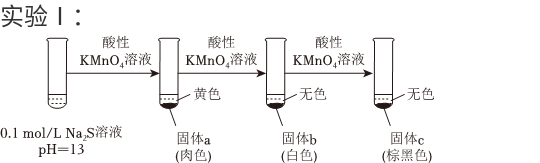
(1) Write the ionic equation that explains why a solution is alkaline: .
(2) Solid a was filtered, washed, and left in air. It became brownish black.
① Student A believed that solid a contained in addition to . The supporting observation was that solid a became brownish black after standing in air.
② Student B argued that this observation alone did not prove that solid a contained and proposed a control experiment: leave in air and observe whether it becomes brownish black within the same amount of time. The experiment confirmed that solid a contained .
(3) The main component of solid b was . Possible reasons for its formation are: acidified oxidizes , , or to ; and converts to under acidic conditions.
(4) Testing showed that the main component of solid c was .
① One possible cause is oxidation of by under acidic conditions. The ionic equation is .
② When more acidified solution was added, the solution became reddish purple while the brownish-black solid remained.
Experiment II: Experiment I was repeated using that had not been acidified. When the brownish-black solid formed, the solution was green.
(5) To determine why no green color was observed in Experiment I, a small amount of the green solution from Experiment II was treated with sulfuric acid. The solution became reddish purple, and a brownish-black solid formed. Write the ionic equation: .
Experiment III: A small amount of was added to unacidified solution. A brownish-black precipitate formed, and was detected.
(6) A procedure for testing is: take a small amount of the supernatant after the reaction and add or solution. A white precipitate forms. Filter the mixture, then add excess hydrochloric acid to the precipitate; it does not dissolve.
TIP: Potassium permanganate + concentrated hydrochloric acid = chlorine.
Note: Under the conditions of this experiment, does not react with .
(7) Taken together, the products of the reaction between and depend on factors such as the amounts of reactants, the order of addition, and the solution pH. Any two factors are sufficient.
Industrial Applications of Manganese and Its Compounds
(2022 Dongcheng First Mock Exam) and its compounds have important industrial applications.
I. An ore containing is dissolved in sulfuric acid to obtain a solution containing . After a series of treatments, the solution is electrolyzed to produce metallic .
(1) is produced at the cathode.
(2) The anode sludge contains . Write the electrode reaction that produces it: .
II. The anode sludge contains both manganese and lead. The following process converts them separately into active and .
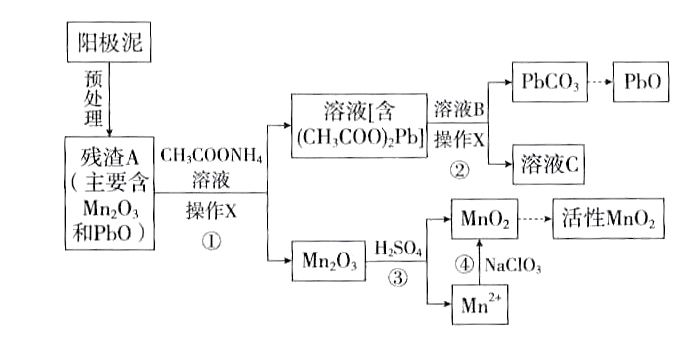
Given: dissociates only slightly in water.
(3) Operation X is filtration.
(4) The ionic equation for reaction ① is .
TIP: Account for the coupling between coordination and acid-base reactions.
(5) Solution C can be recycled. The solute in solution B in step ② is .
(6)
a. To convert all in step ③ into , the theoretical mole ratio of added in step ④ to is . The reduction product of is .
b. Before is added, the solution pH must be raised to about 6. This prevents sodium chlorate and manganese dioxide from oxidizing chloride ions to chlorine when the pH is too low.
TIP: Note how acidity and alkalinity affect the oxidizing power of oxoanion oxidants.
(7) Determination of the purity of active :
i. Dissolve a sample of active in of solution acidified with :
ii. Titrate the remaining with standard acidified solution. The volume consumed is :
The mass fraction of in the sample is .
[]
Apply electron balance:
Investigating Methods for Detecting
(2022 Mentougou First Mock Exam, Question 19) A laboratory group investigated methods for detecting .
Reference information: A dilute solution is almost colorless. In an acidic medium, can oxidize to .
(1) The ionic equation for the detection reaction is .
Student A designed the following experiment.
| No. | Procedure | Observation |
|---|---|---|
| I | Add 3 drops of solution to of solution, then add one rice-grain-sized crystal of | No obvious change after |
(2) The expected observation did not occur in Experiment I. After consulting references, the students performed the following experiments.
| No. | Procedure | Observation |
|---|---|---|
| II | Add 3 drops of solution to of solution, add one rice-grain-sized crystal of , and heat to boiling | The solution becomes brownish yellow; reddish purple appears after |
| III | Add 3 drops of solution to of solution, add one rice-grain-sized crystal of , then add 2 drops of solution | The solution becomes brownish yellow; reddish purple appears after |
| IV | Add 3 drops of solution to of solution, add one rice-grain-sized crystal of , and heat to boiling | A brownish-black precipitate forms rapidly |
① Comparing Experiments II and III suggests that no obvious change occurred in Experiment I because the reaction rate was slow.
② The solution became brownish yellow in Experiments II and III because oxidizes to , but the reaction is slow and the concentration of the formed is relatively low. Boiling or adding increases the reaction rate.
③ The brownish-black precipitate in Experiment IV forms according to .
(3) Student B designed another experiment to complete the table.
| No. | Procedure | Observation |
|---|---|---|
| V | Add 3 drops of solution to of solution, add one rice-grain-sized crystal of and 2 drops of solution, then warm gently | Reddish purple appears after |
(4) Conclusion: Factors that must be considered when developing a method for detecting include temperature, catalyst, and concentration.
Effect of Oxalic Acid Concentration on the Reaction Rate of
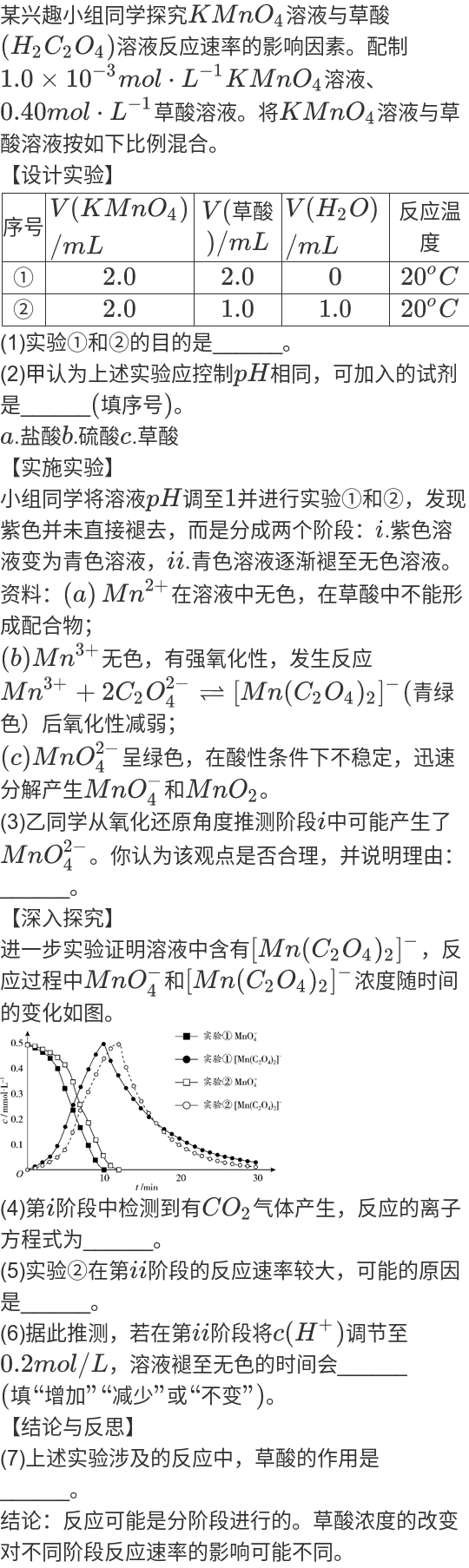
(2022 Haidian First Mock Exam) A student group investigated factors affecting the reaction rate between solution and oxalic acid, , solution. They prepared solution and oxalic acid solution, then mixed them in the proportions shown below.
Experimental Design
| No. | Temperature | |||
|---|---|---|---|---|
| ① | ||||
| ② |
(1) The purpose of Experiments ① and ② is to investigate how oxalic acid concentration affects the reaction rate.
(2) Student A believes that the experiments should be conducted at the same . Which reagent may be added? b (select one).
a. Hydrochloric acid b. Sulfuric acid c. Oxalic acid
Choose an acid whose anion is not reducing.
Experiment
The group adjusted the solution to and performed Experiments ① and ②. The purple color did not fade directly; instead, the change occurred in two stages:
i. The purple solution became cyan;
ii. The cyan solution gradually faded to a colorless solution.
Reference information:
a. is colorless in solution and does not form a complex with oxalic acid;
b. is colorless and strongly oxidizing. It undergoes the reaction
to form a bluish-green complex with weaker oxidizing ability;
c. is green. It is unstable under acidic conditions and rapidly decomposes to form and .
(3) From a redox perspective, Student B proposes that may be formed during stage i. Is this proposal reasonable? Explain your reasoning: No. is unstable under acidic conditions and rapidly decomposes into and , but no black precipitate was observed during stage i.
Further Investigation
Further experiments confirmed the presence of in the solution. The concentrations of and over time are shown below.
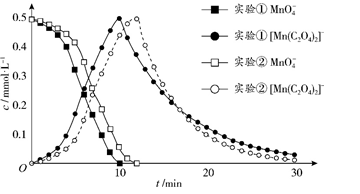
(4) gas was detected during stage i. The ionic equation is .
(5) The reaction rate in stage ii is greater in Experiment ②. One possible reason is Experiment ② has a lower and therefore a lower from ionization. The equilibrium shifts to the left, increasing ; because is strongly oxidizing, the reaction in Experiment ② is faster.
(6) Based on this result, if is adjusted to during stage ii, the time required for the solution to become colorless will decrease (choose “increase,” “decrease,” or “remain unchanged”).
Increasing the acidity suppresses the ionization of oxalic acid, producing the opposite effect to that described in (5).
Conclusion and Reflection
(7) In the reactions involved in these experiments, oxalic acid acts as a reducing agent, while the produced by its ionization forms a complex with .
Conclusion: The reaction may proceed in stages. Changing the oxalic acid concentration may affect the reaction rate differently in different stages.
Summary
The chemistry of manganese is defined by its rich range of oxidation states and pronounced medium effects. is generally the most stable species, is a common intermediate-valence product, and is a powerful oxidant. Their interconversions depend not only on electrode potentials, but also on solution , reactant amounts and order of addition, concentration, temperature, and catalysts. Accurately predicting the direction of a manganese reaction and its final products therefore requires considering redox behavior, acid-base equilibria, precipitation or complexation, and experimental observations together.
TIP: First determine the oxidation state of manganese in the solution; the manganese-containing species can then usually be identified.
Image and Data Sources
- Group 7 acidic Latimer data: official 55th IChO 2023 theory paper and mirror of the official solution
- Manganese Latimer data in acid and base: D. A. Stynes, York University
- Manganese metal, Jurii, CC BY 3.0
- Pyrolusite specimen, Andrew Silver / USGS Mineral Specimens, public domain
- Rhodochrosite, James St. John, CC BY 2.0
- Manganese dioxide, Benjah-bmm27, public domain
- Manganate solution, Choij, public domain
- Potassium permanganate crystals, Walkerma, public domain
- Potassium permanganate concentration series, Leiem, CC BY-SA 4.0
- Potassium permanganate titration, Bhaiyaji Smile 123, CC BY 4.0
- Original 2022 Haidian First Mock chemistry inquiry question


.jpg)