Next, we will discuss based on the difference between positive and negative signs:
2p2−7p+4=0Δ=17>0p=47±17p=47+17,p−2=417−1<1discard this solutionp=47−17,2−p=417+1>1retain this solution
2p2−5p+4=0Δ=25−32<0no real solution
Example 2
(2009 Nanjing University) Draw a circle tangent to the x-axis above the x-axis. The abscissa of the tangent point is 3. The tangents of the circle are drawn through the point B(−3,0),C(3,0). The two tangents intersect at P. Q is the projection of C on the bisector of the acute angle ∠BPC.
(1) Find the trajectory equation of P and the value range of its abscissa.
(2) Find the trajectory equation of Q.
(1)
Apparently ∣PB∣−∣PC∣=∣AB∣−∣AC∣=3+3−(3−3)=23
Point P is located on the right branch of the hyperbola a2x2−b2y2=1: 2a=23,2c=3a=3,c=3,b=6 So the trajectory equation of point P 3x2−6y2=1(x>3)
(2)
Considering extending CQ to intersect PB at point E, we have EQ=QC,PE=PC
In addition, point O is the midpoint of line segment BC, so OQ is the median line opposite to the BE side in △PBCOQ=2BE=2PB−PC=3 Find out what other constraints there are on point Q:
For any point Q (yQ=0) whose distance from the origin is 3, you can always double the length of CQ to get the point, and then extend the intersection of the vertical line in BE and EC to get the point P, so the trajectory equation of point Q is: x2+y2=3(y=0)
Example 3
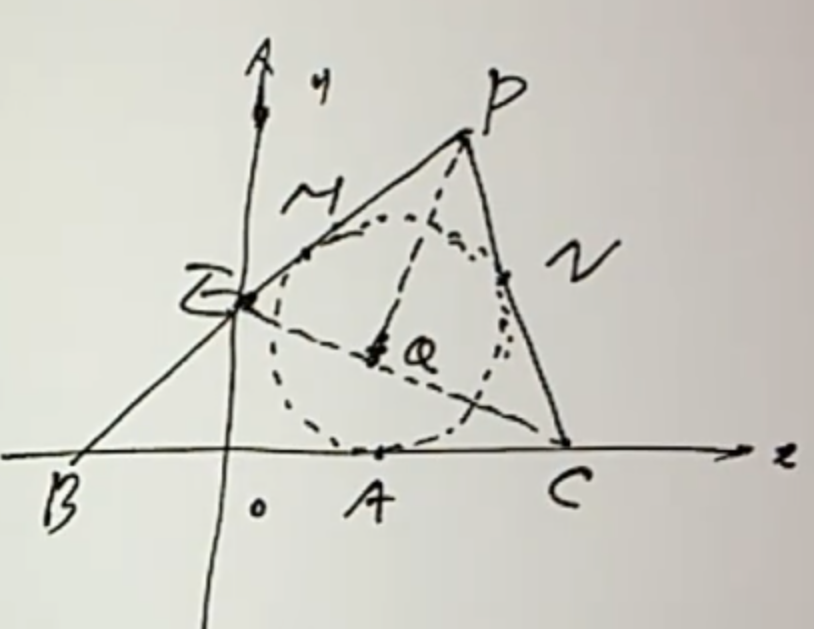
(Self-recruited by Peking University) AB is the point on y=1−x2 on both sides of the y-axis. Find the minimum value of the area enclosed by the tangent line passing through A and B and the x-axis.
Let's assume that A(u,1−u2),B(v,1−v2),u<0<v, point E is the intersection point of the tangent lines passing through points A and B.
Yi Zhi: lAE:y=−2ux+u2+1,lBE:y=−2vx+v2+1,E(2u+v,1−uv)
Let y=0, the length of the base of the triangle on the x-axis is s=21(v+v1−u−u1)
Consider negative substitution: Let t=−u>0 kill two birds with one stone. It not only makes the sign of v,t the same, but also simplifies the area expression.
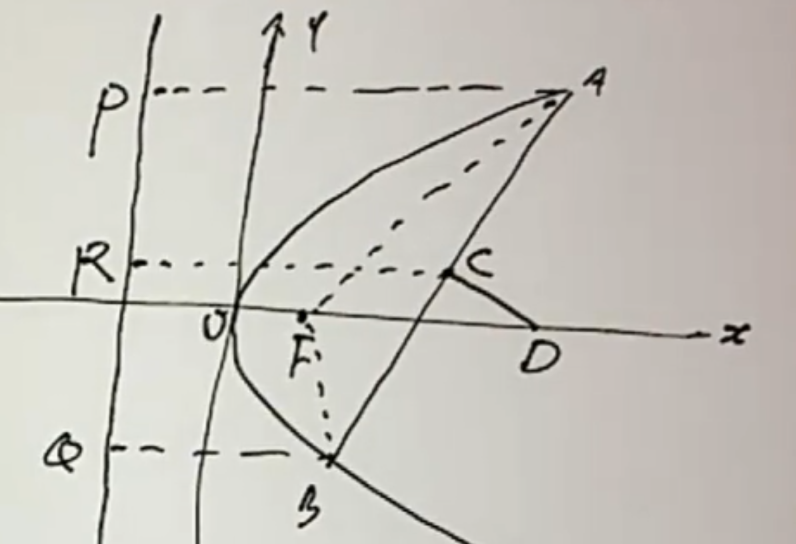
The straight line passing through the focus F of the parabola y2=4x intersects the parabola at two points A and B, and the directrix of the parabola intersects the x-axis at the point C, if ∠OFA=130∘ (O is the coordinate origin), find tan∠ACB.
Find the equation of the straight line passing through the intersection of y=2x2−2x−1 and y=−5x2+2x+3.
5y+2y=5(2x2−2x−1)+2(−5x2+2x+3)=−6x+1
y=7−6x+71
Another method:
{y=2x2−2x−1=kx+b,y=−5x2+2x+3=kx+b
{2x2−(k+2)x−(b+1)=0,5x2+(k−2)x+(b−3)=0
The solutions of the two equations should be exactly the same, so the corresponding vectors of the equation coefficients are parallel. If there is a component with a size of 0, it is obviously a contradiction, so:
52=−k−2k+2=−b−3b+1
Solution: k=−76,b=71
Example 6
Point A is on y=kx, point B is on y=−kx, where k>0,∣OA∣∣OB∣=k2+1 and A,B are on the same side of the y-axis.
(1) Find the trajectory equation C of the midpoint M of AB;
(2) Curve C is tangent to the parabola x2=2py(p>0). Verify that the tangent points are on two fixed straight lines, and obtain the two tangent line equations.
(1)
Let A(x1,y1),B(x2,y2) be given by ∣OA∣∣OB∣=k2+1.
Therefore, the two tangent points are respectively on x=2,x=−2.
Tangent equation: y=2kx−k,y=−2kx−k
Example 7
Assume that the focus of the parabola y2=2px(p>0) is F. A and B are two different points on the parabola. The straight line AB and the x-axis Not perpendicular, the perpendicular bisector of line segment AB intersects the x-axis at point D(a,0), denoted as m=∣AF∣+∣BF∣.
(1) Prove: a is the arithmetic median of p and m;
(2) Assume m=3p, straight line l // y-axis, and l is intercepted by a moving circle with AD as the diameter The chord length is constant, find the equation of the straight line l.
(1)
Set point A(2pu2,2pu),B(2pv2,2pv),kAB=u2−v2u−v=u+v1
lD:y=−(u+v)[x−p(u2+v2)]+p(u+v)
Let y=0,a=x=p(u2+v2+1)
Defined by a parabola: m=p+2p(u2+v2)
So there is: m+p=2a
(2)
From (1): m=p+2p(u2+v2)=3p, then u2+v2=1a=2m+p=2p,D(2p,0)A(2pu2,2pu), equation of circle with AD as diameter:
(x−2pu2)(x−2p)+(y−2pu)y=0
Assume l:x=k and enter the equation of the circle:
This requires that the coefficient of u in the discriminant is 0, that is, k=23p,l:x=23p
Example 8
In the plane rectangular coordinate system xOy, A(−12,0),B(0,6), point P is on the circle O:x2+y2=50. If PA⋅PB≤20, find the range of the abscissa of point P.
Although the range [−52,+1] is obtained in this way, it is difficult to know whether the algebraic deformation is an identity deformation by using the inequality as a condition. Consider using the x2+y2=50 equality as a condition.
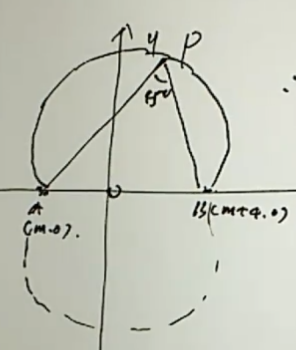
In the plane rectangular coordinate system xOy, the point A(m,0),B(m+4,0) is known. If there is a point P on the circle C:x2+(y−3m)2=8 such that ∠APB=45∘, then the value range of the real number m is ___.
It is easy to know that the trajectory of P is the superior arc at both ends, and the corresponding center points are M1(m+2,2),M2(m+2,−2).
If circle C intersects with the minor arc of a circle, it must intersect with the minor arc of another circle. Therefore, we only need to consider the intersection of circle C with the upper and lower circles respectively.
To sum up, combining the two situations, m∈[5−4−219,2]
If C:x2+(y−3m)2=8 is a smaller circle, you may need to consider and exclude the situation where circle C only intersects minor arcs.
Example 10
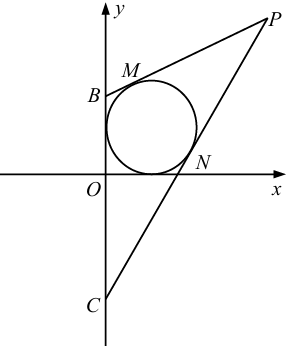
As shown in the figure, in the plane rectangular coordinate system xOy, two tangent lines PM and PN to the circle E:(x−1)2+(y−1)2=1 are drawn through the point P(2t2,2t+1), and the tangent points are M and N respectively.
(1) When t=2, find the equation of straight line MN;
(2) When t∈(1,+∞), assume that the tangent lines PM, PN and the y-axis intersect at points B and C respectively, and find the minimum value of the area of △PBC.
(1) P(8,5),MN:7(x−1)+4(y−1)=1
That is MN:7x+4y−12=0
Another solution: write down the equation of a circle with PE as its diameter, and subtract it from circle E using the curve system.
(2) Let the straight line passing through point P be y=k(x−2t2)+2t+1
The straight line is tangent to the circle E: d=1+k2∣k(2t2−1)−2t∣=1
That is: k2+1=(2t2−1)2k2−4t(2t2−1)k+4t2
Simplify: 4t2(t2−1)k2−4t(2t2−1)k+(4t2−1)=0(∗)
Δ=16t2(2t2−1)2−16t2(4t2−1)(t2−1)=16t4
Let the two roots of (*) be k1,k2.
Let x=0,y=−2t2k+2t+1, then ∣BC∣=2t2∣k1−k2∣=2t24t2∣t2−1∣4t2=∣t2−1∣2t2,h=2t2
S△PBC=21∣BC∣h=∣t2−1∣2t4≥8(t=±2)
Example 11
Assume that the eccentricity of the ellipse C:a2x2+b2y2=1(a>b>0) is e=23, and the straight line y=x+2 is tangent to the circle O with the origin as the center and the minor axis length of the ellipse C as the radius.
(1) Find the equation of ellipse C;
(2) As shown in the figure, A1, A2, B1, B2 are the vertices of the ellipse C, P is any point on the ellipse C except the vertex, and the straight line B2P intersects the axis of x at the point F, straight line A1B2 intersects A2P at point E. Suppose the slope of A2P is k and the slope of EF is m. Verify: 2m−k is a constant value.
(1) b=d=1,e=ac=aa2−b2=23,a=2b=2
Therefore C:4x2+1y2=1
(2)
Compilation of answers to analytical geometry proof questions
Known conditions: Ellipse C:4x2+y2=1 (obtained according to the first question). A1(−2,0),A2(2,0),B1(0,−1),B2(0,1) is the vertex of the ellipse. At the position of point P different from the vertex on the ellipse, the slope of A2P is k, and the slope of EF is m.
**Proof goal:**2m−k is a constant value.
Proof process:
Step 1: Determine the equation of the straight line A2P and find the coordinates of the intersection point P Let the equation of straight line A2P be: y=k(x−2) From the question, we know k=0. Simultaneously combine the equations of the straight line and the ellipse to find the coordinates of the point P: {y=k(x−2)x2+4y2=4 Substituting the equation of the straight line into the equation of the ellipse we get: x2+4k2(x−2)2=4(4k2+1)x2−16k2x+(16k2−4)=0 Since A2 is an intersection point of a straight line and an ellipse, let its abscissa be x1=2, and the abscissa of another intersection point P be xP. From Vedic theorem we can get: x1⋅xP=4k2+116k2−4⟹2xP=4k2+14(4k2−1)⟹xP=4k2+12(4k2−1) Substitute into the equation of the straight line to obtain the ordinate of P: yP=k(xP−2)=k(4k2+12(4k2−1)−2)=k⋅4k2+1−4=−4k2+14k Therefore, the coordinates of point P are (4k2+12(4k2−1),−4k2+14k).
Step 2: Find the coordinates of point F The intersection point of the straight line B2P and the x axis is F(u,0). Find the slope kB2P of the straight line B2P from the coordinates of B2 and P: kB2P=kB2F=4k2+12(4k2−1)−0−4k2+14k−1=4k2+12(4k2−1)4k2+1−4k−4k2−1=2(4k2−1)−(4k2+4k+1) Using the slope formula kB2F=u−00−1=−u1, we can get: −u1=2(4k2−1)−(4k2+4k+1)⟹u=(2k+1)22(4k2−1)=(2k+1)22(2k−1)(2k+1)=2k+12(2k−1) Therefore, the coordinates of point F are (2k+12(2k−1),0).
Step 3: Find the coordinates of point E The equation of the straight line A1B2 is: y=21x+1 Simultaneous straight lines A2P (y=k(x−2)) and A1B2 find the intersection point E: 21x+1=k(x−2)⟹x−2kx=−4k−2⟹x(1−2k)=−2(2k+1)x=2k−12(2k+1) Substituting y=21x+1 we get: y=21⋅2k−12(2k+1)+1=2k−12k+1+2k−1=2k−14k Therefore, the coordinates of point E are (2k−12(2k+1),2k−14k).
Step 4: Calculate the slope m and prove the fixed value Based on the coordinates of E and F, calculate the slope m of the straight line EF: m=xE−xFyE−yF=2k−12(2k+1)−2k+12(2k−1)2k−14k−0m=(2k−1)(2k+1)2(2k+1)2−2(2k−1)22k−14k=(2k−1)(2k+1)2⋅8k2k−14k=2k−14k⋅16k(2k−1)(2k+1)=42k+1
Conclusion:2m−k=21 is a fixed value and is proved.
Example 12
(2018 Beijing Liberal Arts) It is known that the eccentricity of the ellipse M:a2x2+b2y2=1(a>b>0) is 36 and the focal length is 22. A straight line l with slope k and an ellipse M have two different intersection points A,B. (1) Find the equation of ellipse M; (2) If k=1, find the maximum value of AB; (3) Assume P(−2,0), the other intersection point of straight line PA and ellipse M is C, and the other intersection point of straight line PB and ellipse M is D. If C,D and point Q(−47,41) are collinear, find k.
(1) 3x2+y2=1 (2) 6
(3) Let A(x1,y1),B(x2,y2),C(x3,y3),D(x4,y4)
It is known that the left focus of ellipse C:a2x2+b2y2=1(a>b>0) is F(−1,0), and the left directrix equation is x=−2.
(1) Find the standard equation of the ellipse C;
(2) It is known that the straight line l intersects the ellipse C at two points A,B.
① If the straight line l passes through the left focus F of the ellipse C, intersects the y axis at the point P, and satisfies PA=λAF, PB=μBF.
Verify: λ+μ is a fixed value;
② If the two points A,B satisfy OA⊥OB (O is the origin of the coordinates), find the value range of the area of △AOB.
(1) c=1,ca2=2,a=2,b=1,C:2x2+1y2=1
(2) ① Consider the focal chord length formula: Suppose the inclination angle of the straight line l is θ, then:
AF=1−ecosθab2=1−22cosθ21=2−cosθ1BF=2+cosθ1PA=PF−AF=cosθ1−2−cosθ1PB=PF+BF=cosθ1+2+cosθ1λ=+AFPA=AFPF−1μ=−BFPB=−BFPF−1λ+μ=−2+cosθ(2−cosθ)−(2+cosθ)=−4 ②Suppose the straight line AB:y=kx+b.
When the slope of straight line AB does not exist, ∣OA∣=∣OB∣=34,S△AOB=21∣OA∣∣OB∣=32(u→0)
Here is a summary of the answers (a different wiring scheme):
Reference answer
[Instruction from Famous Teachers] This question examines the standard equations, geometric properties of ellipses, and the positional relationship between straight lines and ellipses. (Ⅰ) Use the geometric properties of the ellipse to solve the basic quantities and obtain the standard equation of the ellipse; (Ⅱ) (ⅰ) Set up the linear equation, combine it with the equation of the ellipse, and use Veda's theorem and coordinate operations of vectors to solve it; (ⅱ) Use the triangle area formula to establish the objective function, and then use the substitution method, quadratic function, etc. to solve the value range.
Solution: (Ⅰ) Assume from the question that c=1, and ca2=2, that is, a2=2c, ∴a2=2,b2=a2−c2=1, The equation of ∴ ellipse C is 2x2+y2=1.
(Ⅱ) (ⅰ) Proof: It is assumed from the question that the slope of the straight line l exists, F(−1,0), Suppose the equation of straight line l is y=k(x+1), then P(0,k). Let A(x1,y1),B(x2,y2), Substituting the equation of the straight line l into the equation of the ellipse, we get x2+2k2(x+1)2=2, Organized into (1+2k2)x2+4k2x+2k2−2=0, ∴x1+x2=1+2k2−4k2,x1x2=1+2k22k2−2. From PA=λAF,PB=μBFwe know, λ=1+x1−x1,μ=1+x2−x2, ∴λ+μ=−1+x1+x2+x1x2x1+x2+2x1x2=−1+1+2k2−4k2+1+2k22k2−21+2k2−4k2+1+2k24k2−4=−−1−4=−4 is a fixed value.
(ⅱ) When the straight lines OA,OB coincide with the coordinate axes respectively, It is easy to know the area of △AOBS=22, When the slopes of the straight line OA,OB all exist and are not zero, Let OA:y=kx,OB:y=−k1x, Assume A(x1,y1),B(x2,y2), substitute y=kx into the equation of ellipse C, Get x2+2k2x2=2, ∴x12=2k2+12,y12=2k2+12k2, In the same way, x22=2+k22k2,y22=2+k22, The area of △AOB is S=2OA⋅OB=(2k2+1)(k2+2)(k2+1)2. Let t=k2+1∈(1,+∞), S△AOB=(2t−1)(t+1)t2=2+t1−t211, Let u=t1∈(0,1), Then S△AOB=−u2+u+21=−(u−21)2+491∈[32,22). To sum up, the value range of △AOB area is [32,22].