It is known that the ellipse C:4x2+3y2=1 and the function y=mx+1+n(m≥2) intersect the ellipse at two points A,B, and find the maximum value of n.
Assume A(x0,y0),B(−x0,−y0),x0∈(0,2),y0∈(0,3), there are: ⎩⎨⎧y0=mx0+1+n,(1)−y0=m−x0+1+n,(2)4x02+3y02=1,(3) Considering that there are a total of four variables x0,y0,m,n and three constraints, there are 4−3=1 degrees of freedom.
Obviously if the scope of one of the variables can be determined, the scope of the other variables will be easily determined:
In order to use symmetry while obtaining identical deformation, consider (1)+(2) and (1)-(2), then the sufficient and necessary conditions are:
(α) is the key to solving the problem! It is not difficult to see that 4x02+322x0+2−2x0−2 is monotonically increasing with respect to x0, and the solution is x0≤1.
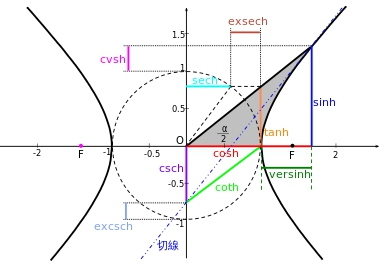
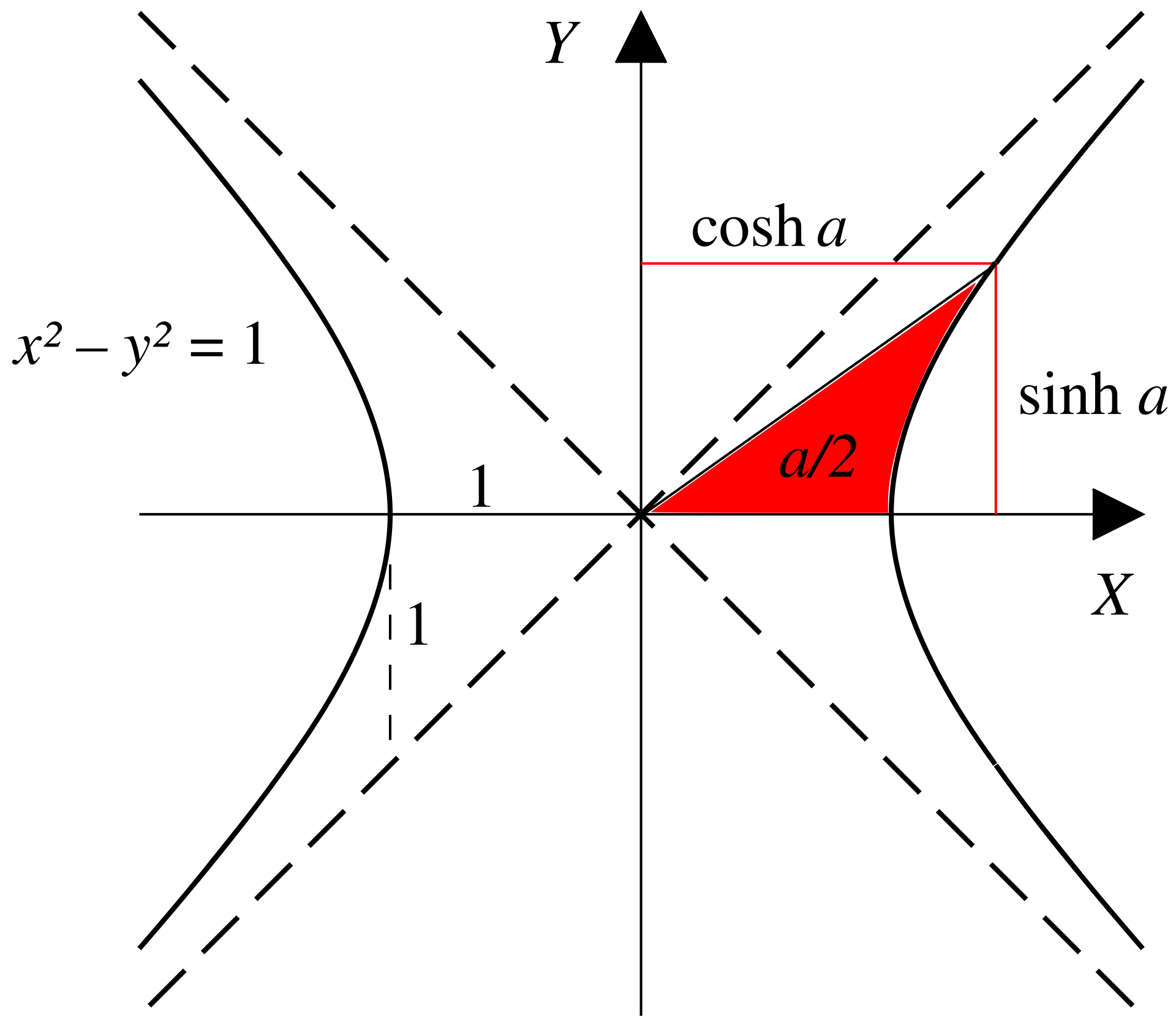
When dealing with Example 1 (4) (5), you can also use the analogy of cosh2x−sinh2x=1 and consider the squares and then add them.
Example 2
If f(x)=ax−1 and g(x)=logax+1 have three intersection points, find the value range of a:
When a>1, f(x)=ax−1 increases monotonically, and f(x),g(x) are inverse functions of each other, then if the intersection point is not on y=x:
Suppose the intersection point is (x,y), then there must be a pair of intersection points (y,x), and as long as x=y, it is inconsistent with monotonicity.
This means that y=ax−1 as a downward convex function has two intersection points with y=x, which obviously leads to a contradiction:
Therefore, 0<a<1, at this time, there is obviously an intersection point (1,1), and the other two intersection points cannot be on y=x, then the two paired intersection points are not on y=x, and there is a pair of (x,y),(y,x) that is an intersection point that meets the meaning of the question:
The above are the necessary conditions for the existence of x,y.
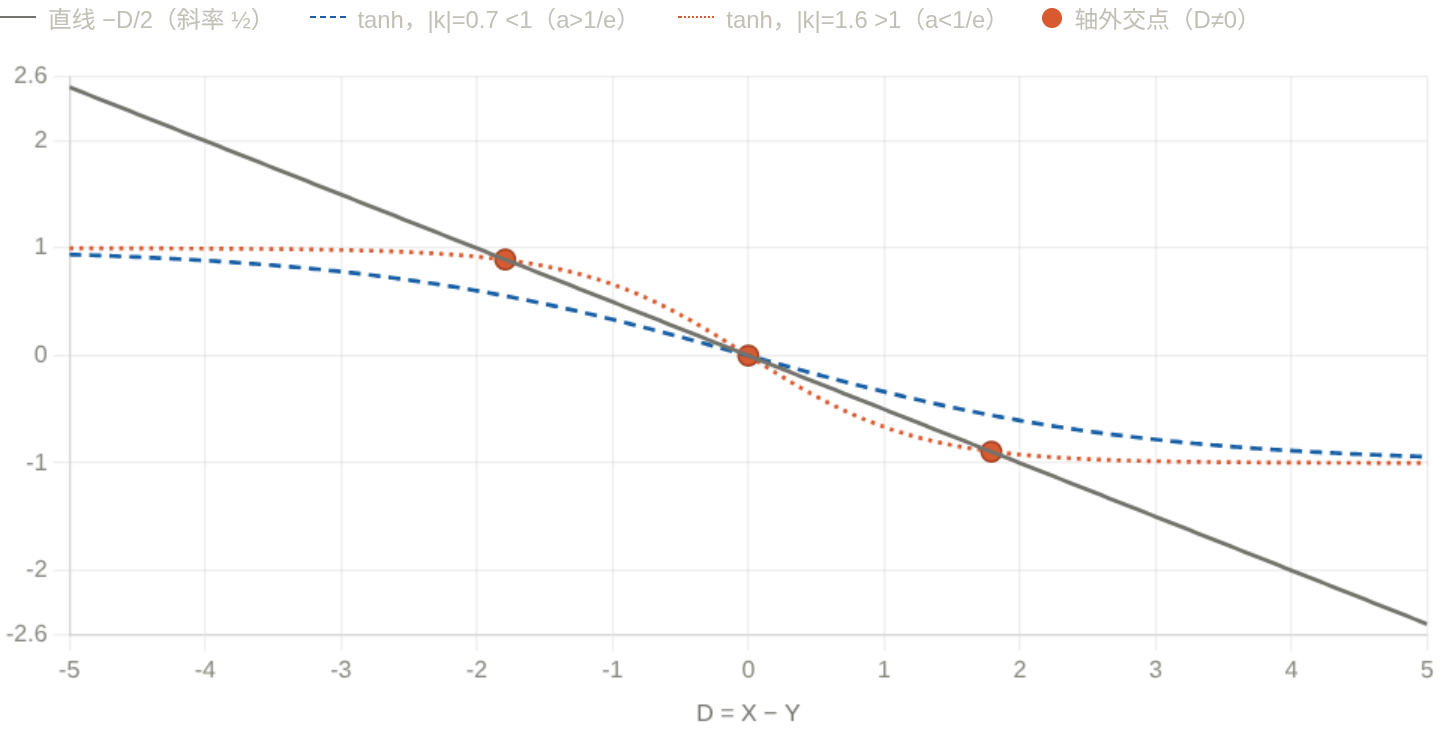
When S is fixed, y=−S+21D is a straight line, considering that it has three intersection points with y=tanh(2kD).
Obviously, it can be seen from the image that the slope of y=tanh2kD at D=0 is 2k.
Then if −S+21>2k, then the straight line and the hyperbolic tangent function will have three intersection points.
If −S+21≤2k, then there is only one intersection point between the straight line and the hyperbolic tangent function.
From (3):
S+2=eku+ekv≥2ek2S
If S<0, then 2>S+2≥2ek2S>2, resulting in a contradiction.
So S≥0.
Critical condition S→0,k→−1,a→e1
Replace "ratio slope at S→0" with a single variable, global argument to completely avoid the trouble of entanglement of two unknown quantities. The cleanest thing is to go back to a fixed point language.
Assume f(x)=ax−1 (0<a<1), the axis outer pair is the fixed point of g(x)=f(f(x)) except x=1. inspection
ψ(x)=f(f(x))−x,ψ(1)=0.
**Step 1: ψ Up to 3 zero points. ** To calculate the derivative, record w(x)=f(x)+x−2, then
ψ′(x)=f′(f(x))f′(x)−1=(lna)2aw(x)−1.
Moreover, w′(x)=ax−1lna+1 is strictly increasing, so w first decreases and then increases and has a unique minimum. Therefore, when the base is less than 1, aw(x) first increases and then decreases. Thus ψ′ is also unimodal: although it tends to −1 at both ends, it may become positive in between. Hence ψ′ changes sign at most twice, and ψ has a decrease–increase–decrease profile with at most three zeros. By inverse-function symmetry, nontrivial zeros occur in pairs, so there is at most one off-axis pair.
**Step 2: The threshold is exactly ψ′(1)=0. ** At the known zero point x=1,
ψ′(1)=f′(1)2−1=(lna)2−1.
If (lna)2≤1 (i.e. a≥e1): then ψ′(1)≤0. Combined with the single-peak structure, it can be verified that ψ no longer crosses zero on both sides of x=1 (it crosses down at 1, and both ends are also facing −, and the positive peak in the middle cannot reach to create a new intersection point if it exists), so there is only one zero point** and only one intersection point for x=1.
If (lna)2>1 (that is, a<e1, because lna<0 is lna<−1): then ψ′(1)>0, ψ crosses the zero point at x=1. However, ψ(x)→+∞(x→−∞) and ψ(x)→−∞(x→+∞) (use 0<a<1 to directly test the limits at both ends), combined with the "decrease, increase and decrease" shape caused by a single peak, x=1 forces a new zero point on both sides**, which is exactly a pair of off-axis solutions.
**Step Three: Continuity Closure (replacing your S→0). ** The second step is sufficient and necessary, but if you want to clarify "why this pair of solutions was born at a=e1": ψ′(1)=(lna)2−1 continues with a, and when a↑e1 is ψ′(1)↓0, the pair of zero points are continuously merged into x=1 (that is, D→0). This is the correct origin of the "S→0" phenomenon - it is the ultimate behavior of the conclusion, not a criterion used as a premise.
Therefore, it is important to:
three intersections⟺(lna)2>1and0<a<1⟺0<a<e1.
Example 3
(2021 Tsinghua Strong Foundation) defines x∗y=1+xyx+y, then (...(2∗3)∗4)...)∗21=__.
It is not difficult to see that the background of this question is the hyperbolic tangent function.
Let x=u+1u−1,y=v+1v−1,x∗y=uv+1uv−1, where:
{u=−x−1x+1,v=−y−1y+1
Note g(x)=−x−1x+1, then:
(x∗y)∗z=(g(x)g(y)+1g(x)g(y)−1)∗z=g(x)g(y)g(z)+1g(x)g(y)g(z)−1(...(2∗3)∗4)...)∗21=g(2)g(3)...g(21)+1g(2)g(3)...g(21)−1 Among them g(2)g(3)g(4)...g(21)=1−32−43−5...20−22=1×221×22=231